
More Than a Renovation, Here’s How Mobile Infrastructure Saves Hospitals Millions During Construction
For hospital executives and construction firms, a new wing or a renovated department represents progress. But between the groundbreaking and the ribbon-cutting lies a dangerous gap: construction downtime.
Every renovation brings unavoidable challenges, however, the true danger lies in the "hidden cost" of construction: interrupted operations, reduced bed capacity, and patient diversion. When patient-care areas go offline, hospitals face measurable losses that extend far beyond temporary inconvenience, they face a significant financial risk event.
The High Price of "Going Dark"
The financial impact of closing a clinical area, even temporarily, is staggering. According to healthcare industry benchmarks, the interruption of clinical operations comes with steep, quantifiable losses:
Surgical Services: A mere 10-bed recovery area shutdown for 90 days can eliminate between $2 million and $10 million in billable surgical volume.
Inpatient Capacity: A 10-bed temporary closure for a six-month renovation represents $2.7 million to $4.0 million in lost earnings.
Emergency Diversions: The cost in lost revenue and downstream admissions averages $8,000 to $13,000 per hour.
Operational Continuity
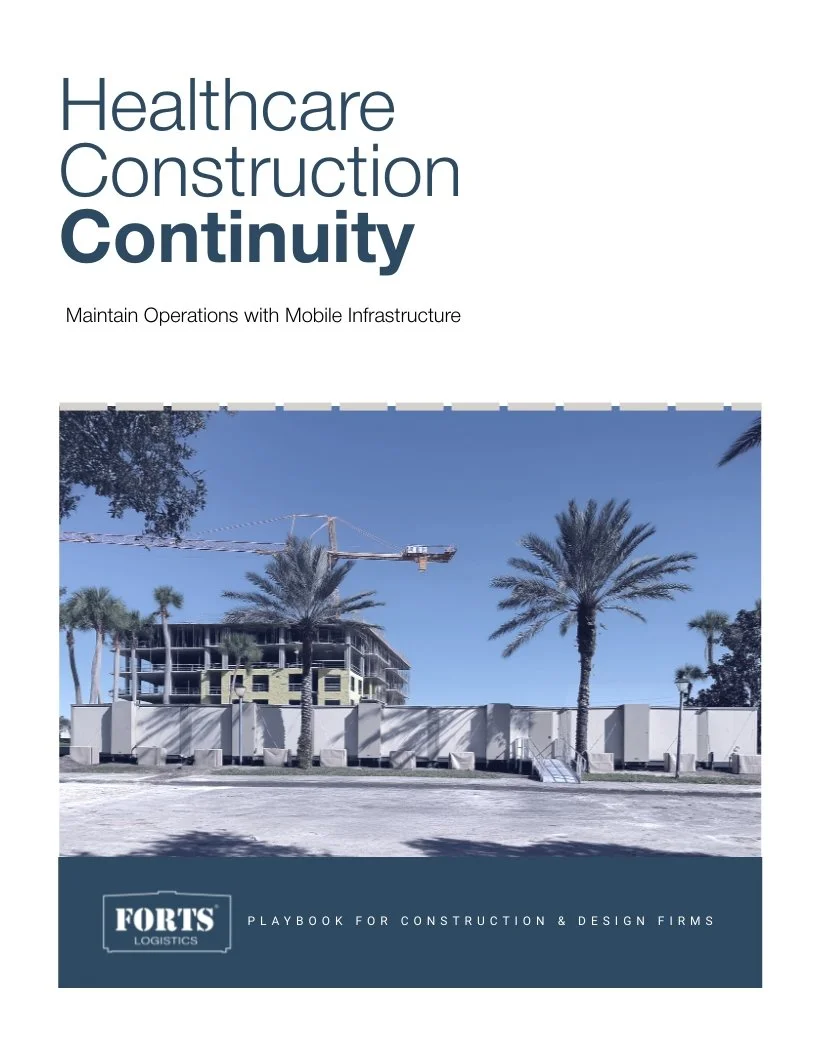
To stop these losses, construction and design firms are shifting their strategy. Instead of simply shutting down a wing, they are deploying mobile infrastructure to ensure essential clinical operations remain active. This isn’t about setting up simple tents in a parking lot. Leading firms are utilizing advanced solutions like the FORTS® M.A.S.H. (Mobile Advanced Specialty Hospital) system. These are turnkey, hard-walled structures engineered to operate at true hospital-grade standards. By incorporating these units into project plans, hospitals can remain fully or partially operational throughout renovations, minimizing downtime and protecting revenue.
Hospital-Grade Specs in a Mobile Package
What makes modern mobile infrastructure a viable replacement for a permanent wing?
It comes down to integration and durability.
Full Utility Integration
These units are designed to function as seamless extensions of the hospital. They feature integrated plumbing, data ports for IT networks, and precision HVAC systems capable of maintaining strict temperature and humidity controls,. Crucially, they can integrate with a hospital’s medical oxygen and air supply lines, or utilize independent, FDA-approved medical gas support trailers,.
Adaptability
Whether a hospital needs a private administrative office or a large, open-plan triage area, mobile units can be configured to fit. "Tandem" configurations link units together to create unified patient-care zones, while single units can serve as isolated exam rooms. They are suitable for high-acuity uses, including:
Operating Rooms and ICUs
Imaging Suites (CT, MRI)
Dialysis Suites and Isolation Wards
Sterile Processing and Pharmacies
Extreme Durability
Construction happens everywhere, from coastal regions to freezing northern climates. These systems are built to withstand 170 mph winds, maintain interior comfort in temperatures ranging from -40°F to 131°F, and handle snow loads of up to 50 psf.
Building Resilience, Not Just Facilities
For construction and design firms, offering mobile infrastructure is a major competitive advantage. It allows them to present a continuity plan rather than just a renovation plan. By using programs like RapidReserve™, firms can guarantee access to these assets, ensuring their healthcare clients never have to divert a patient or close a bed due to construction.
Ultimately, the goal of healthcare construction continuity is simple: protect the workflow. When construction partners integrate mobile infrastructure, they aren't just building facilities, they are building resilience, ensuring that patient care continues uninterrupted, no matter how complex the renovation.