
The Decision You'll Replay Long After the Emergency Ends
Why space contingency belongs on the CEO's risk register, not the facilities punch list.
There are decisions in healthcare that get full board attention. Capital budgets. Service line expansion. EHR conversions. Equipment replacement cycles. Bond issuance and covenant strategy. Most of those decisions are important. They are also decisions your organization has practiced making, however there is one decision most executive teams never rehearse until the day it can no longer be deferred:
"Are we truly prepared if this hospital suddenly loses the physical space it depends on?"
Not prepared on paper. Prepared in reality with square footage that can be standing, powered, climate-controlled, and clinically usable within hours. Because emergencies don't wait for board approval. They don't wait for construction to finish. They don't wait for the next capital cycle. They arrive unannounced and immediately convert a governance question into an operational one. When that happens, the CEO, the chief risk officer, the CMO, the CNO, the emergency management coordinator, and the facilities director all inherit the same mandate at the same moment:
Keep patient care moving.
The Gap Between Compliance and Capability
Every accredited hospital has an emergency operations plan. Under the CMS Conditions of Participation at 42 CFR § 482.15, that plan must be built on an all-hazards approach and grounded in a facility- and community-based risk assessment, with policies, communications, and training and testing behind it. Joint Commission's rewritten Emergency Management chapter goes further, requiring a written continuity of operations plan — including a plan for a secondary location — under EM.13.01.01.
Those requirements are the floor, not the ceiling.
A binder cannot create additional patient rooms. A tabletop exercise cannot restore a flooded imaging suite. A hazard vulnerability analysis can tell you that your ED is a single point of failure; it cannot open a second one.
Compliance answers the question: Do we have a plan?
Risk management answers a harder question: If we activate that plan on a Tuesday afternoon, what physically shows up, how fast, and who has already signed for it?
The distance between those two answers is where the enterprise risk actually lives.
What Loss of Space Actually Costs
Preparedness is usually debated in the language of budgets, capital expenditure, insurance premiums, grant funding, construction contingency. Those are the numbers that make it into the board packet.
They are also the smallest part of the exposure.
When clinical space goes offline, the losses stack in ways your finance team will be reconciling for four quarters:
Volume you never recapture. Every hour on diversion is a patient who enters a competitor's system often with their downstream imaging, procedures, and follow-up care attached. Market share lost during a disruption rarely returns on its own.
Contribution margin from cancelled cases. Elective surgical and procedural volume is the margin engine of most health systems. A closed OR block is not deferred revenue; a meaningful share of it is permanently lost revenue against fixed cost that keeps accruing.
Labor cost inflation. Compressed space means overtime, agency premiums, and travelers at the exact moment when the local labor market is also under strain.
Regulatory and accreditation exposure. Sustained inability to maintain safe care environments and continuity of services invites survey findings, condition-level deficiencies, and remediation costs that outlast the event itself.
Liability and claims exposure. Delayed care, boarding, transfers, and workarounds are the documented conditions under which adverse events cluster and under which plaintiffs later ask what alternatives leadership had considered.
Credit and covenant pressure. Rating agencies and lenders read disruption through days-cash-on-hand and operating margin. A prolonged capacity loss is a balance sheet event, not a facilities event.
Workforce attrition. The nurse who works six months in improvised conditions doesn't file a report. She files a resignation.
None of that appears on a single line item. All of it lands on the CEO.

Real-World Example, Growth Creates Opportunity and Operational Risk
Across the country, health systems are investing billions of dollars to expand capacity and meet growing patient demand. A recent example is University Health in San Antonio, which announced plans to increase inpatient beds and clinical space during construction of its new community hospitals after patient demand projections exceeded original expectations.
Rather than waiting until the facilities opened, leadership adjusted the project while construction was still underway to better serve the community. It's the kind of forward-thinking decision healthcare leaders make every day. But projects of this scale also raise an important question.
What happens if critical clinical space becomes temporarily unavailable during construction?
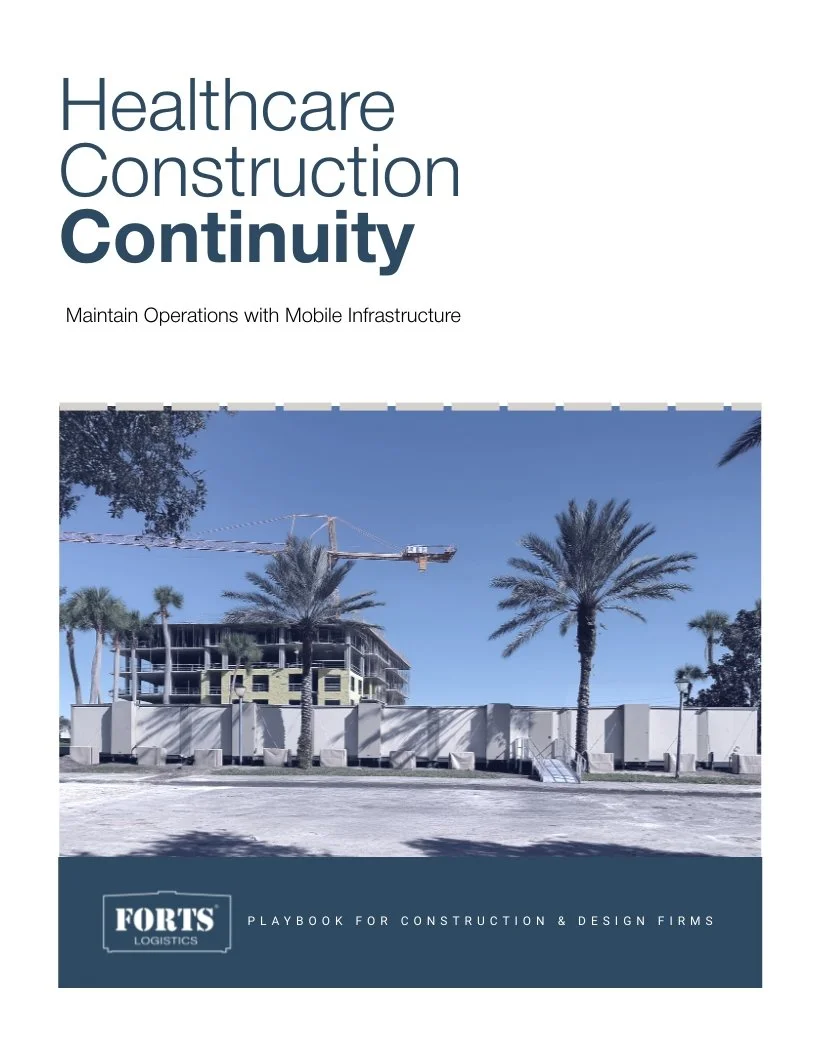
Whether the cause is an unexpected construction delay, a utility interruption, a weather event, or simply the need to renovate an existing department while new facilities come online, patient care must continue without interruption. This is where continuity planning becomes more than an emergency preparedness exercise, it becomes a strategic operational advantage. Deployable infrastructure can provide temporary clinical space, command operations, staff support facilities, or specialty treatment areas while permanent construction continues, allowing hospitals to maintain services, protect revenue, and reduce disruption for patients and caregivers.
The lesson isn't that hospital expansions need mobile infrastructure. The lesson is that every major healthcare project deserves a continuity strategy alongside its construction strategy.

The Questions You Do Not Want to Ask for the First Time During an Event
No executive takes the role expecting perfect conditions. Healthcare leaders are fluent in uncertainty. What no leader wants is to be standing in an incident command center asking questions that should have been closed out twelve months earlier.
Where do we move patients?
How do we keep the Emergency Department open if the Emergency Department is the compromised space?
What deployable clinical capacity is already reserved for us?
Is it contractually guaranteed or are we competing with every other hospital after the disaster has already begun?
How quickly can replacement space become operational?
Who authorizes deployment at two o'clock in the morning?
Where do our caregivers rest if their own homes have also been affected?
These aren't hypothetical questions.
Hospitals across the country have lost clinical capacity because of hurricanes, flooding, wildfires, utility failures, infrastructure damage, infectious disease outbreaks, cyber incidents, and construction delays. The buildings changed overnight.
The obligation did not.
Scarcity Is the Second Disaster
Every emergency creates a resource market, and that market turns against you the moment you enter it.
Temporary space becomes regionally scarce within hours. Contractors are committed. Equipment lead times extend. Transportation corridors close. Mutual aid partners are managing their own event, because a hazard that hit you almost certainly hit them.
Organizations that recover fastest are rarely the lucky ones. They recover because the decisive commitments vendor selection, reserved capacity, site preparation, utility tie-ins, licensure and survey pathways, funding authority, were made while the sun was out and procurement had leverage.
Reacting is buying in a seller's market during your worst week.
Leading is having already bought optionality when it was cheap.
Reframing Preparedness as an Asset, Not an Expense
Hospital leaders have spent a decade institutionalizing high reliability in patient safety, quality, and revenue cycle. Continuity of physical capacity deserves the same rigor and the same seat in enterprise risk management.
Pre-arranged, deployable infrastructure hard-walled clinical space, mobile medical units, incident command facilities, staff housing, and supporting utilities changes the character of the conversation.
Instead of: "Where do we find capacity?"
The conversation becomes: "Activate the plan."
That single shift compresses your recovery timeline, protects contribution margin, keeps your community's care local, and lets the executive team spend the first 48 hours on patients and people rather than on procurement.
Peace of mind is not a soft benefit. It is measurable in days of downtime avoided.
Five Questions for Your Next Risk Committee Meeting
Bring these to the table before your next hurricane season, construction start, or survey window:
Quantify it. If we lost 20% of licensed beds or two ORs for 60 days, what is the modeled hit to operating margin, days cash on hand, and market share?
Time it. What is our documented time-to-operational for replacement clinical space today — and who validated that number?
Contract it. Is our surge capacity guaranteed by an executed agreement with priority access, or is it an assumption?
Certify it. Has anyone confirmed the licensure, life-safety, infection prevention, and survey readiness pathway for that space in advance?
Fund it. Who holds the authority to spend on day one, before FEMA, insurance, or grant reimbursement arrives?
If any answer is "we'd have to look into that," the finding belongs on the risk register this quarter, not after the event.
The Decision You'll Replay Long After the Emergency Ends
Every emergency eventually ends. The floodwaters recede. Construction finishes. Utilities come back. Patients return. The news cycle moves on. The decisions made during those days stay with the people who made them. Some leaders look back knowing every reasonable option had already been secured. Others spend a long time wondering what a single pre-event conversation might have changed. Preparedness isn't pessimism. It is the operational form of the obligation you accepted when you took responsibility for a community's care. When patients, physicians, nurses, and families look to your organization on its hardest day, no one will ask what was allocated in the preparedness budget.
They will only remember whether the hospital was ready. And when it's over, the decision you replay won't be the one you made during the crisis.
It will be the one you made long before it began.

What is
RapidReserve™ ?
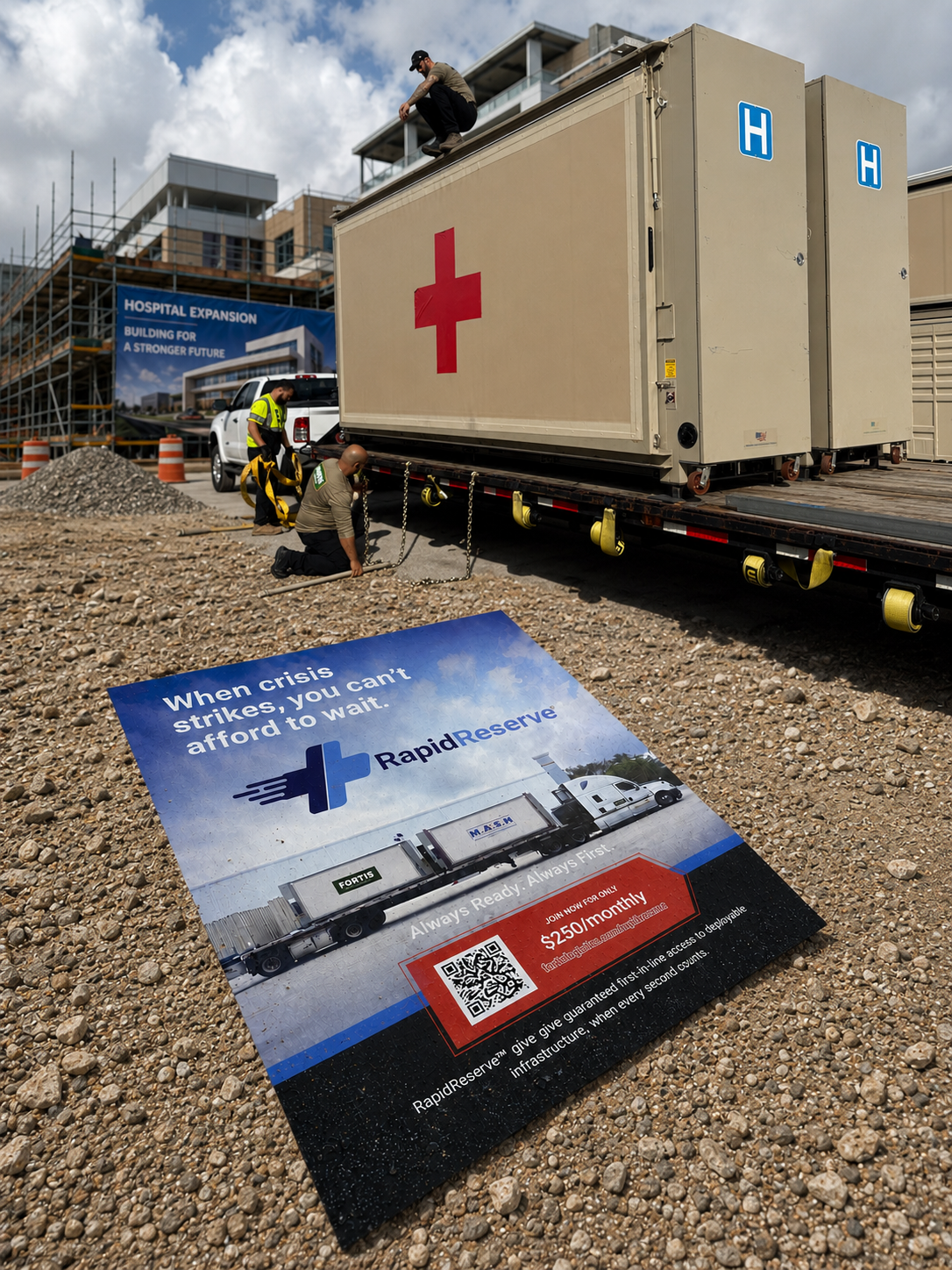
RapidReserve™ is not just another vendor or contract. It’s a peace of mind. Knowing that when your hospital suddenly needs additional clinical space, command operations, isolation capability, staff housing, or continuity infrastructure, you already have a plan in place. Instead of searching for solutions during the emergency, your solution is already reserved.
That changes the conversation from:
"Where can we find help?" to "Activate our deployment."
Is Your Hospital Ready?
Preparedness isn't measured by the plans you write, it's measured by the capabilities you can activate when they matter most. Discover how FORTS® RapidReserve™ helps hospitals secure priority access to deployable clinical infrastructure before the next disruption occurs.
Request a preparedness consultation or deployment quote today.
24/7 Emergency Support 800-776-0403 | Request Quote | Call (954) 949-3200 | Learn More about RapidReserve™
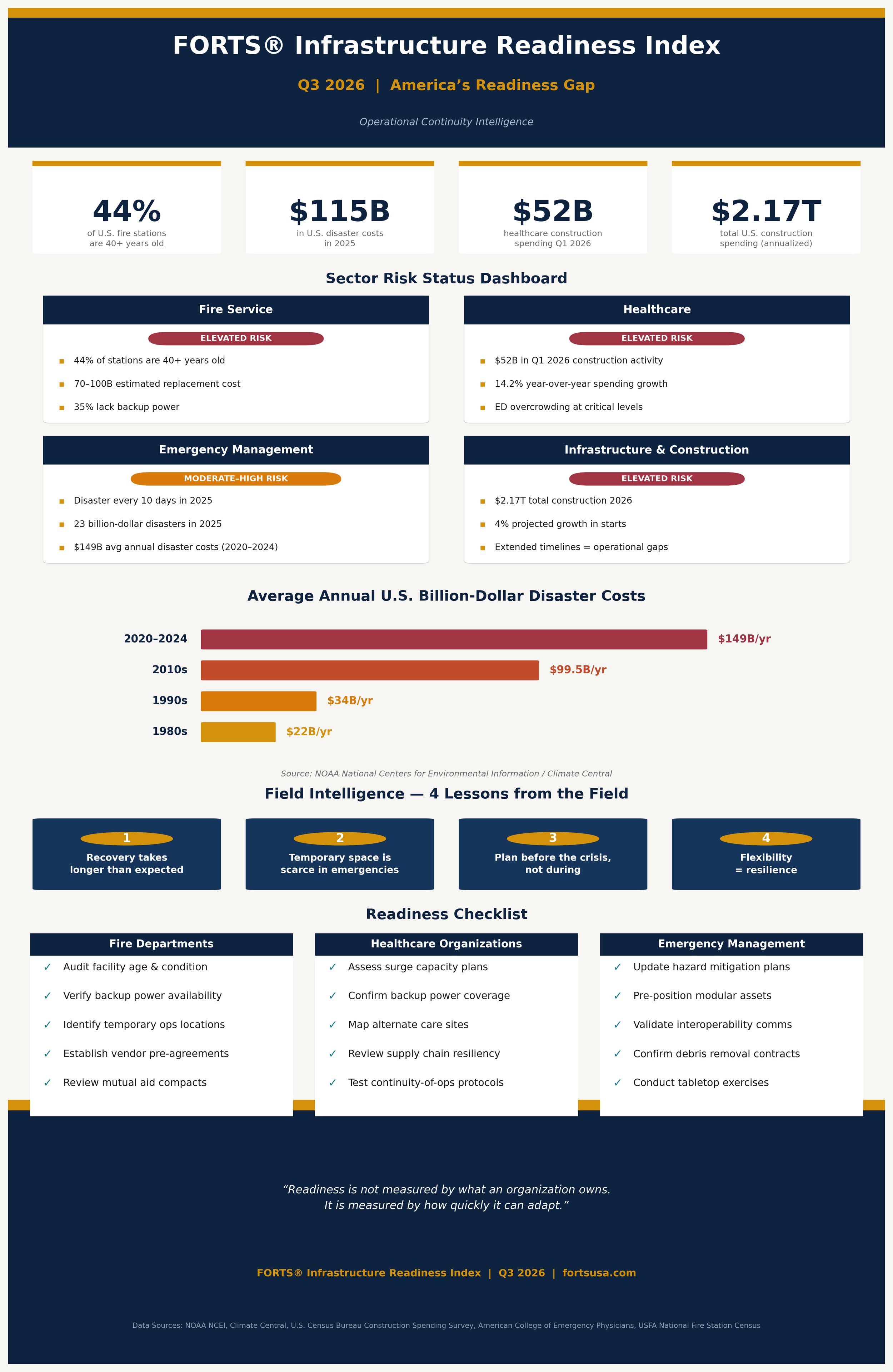
Download Now - The FORTS® Infrastructure Readiness Index
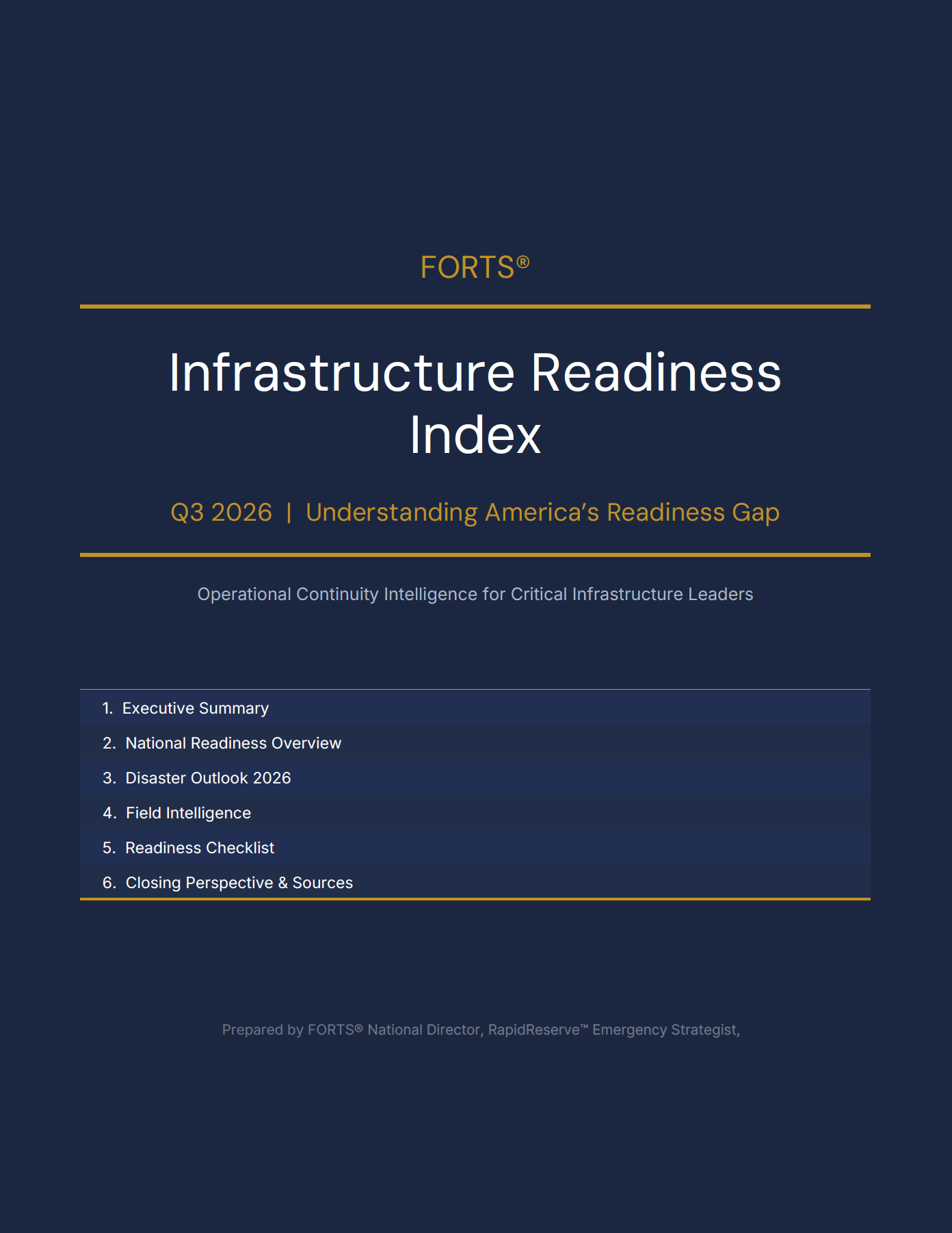
FORTS Infrastructure Readiness Index Report